Modernizing HR Workflows: From Manual Tracking to No-Code Systems of Record

Manual HR systems are a quiet productivity killer. Endless spreadsheet updates, missing documents, and disconnected data sources don't just waste time—they make strategic workforce decisions nearly impossible. When employee information is scattered across multiple files and systems, HR professionals spend more hours hunting for data than analyzing trends or supporting organizational goals.
No-code HR workflows offer a practical escape from these bottlenecks—no technical expertise or lengthy implementation required. These platforms let you build custom applications that mirror your existing processes while eliminating the data accuracy issues and administrative burden that come with manual tracking.
The result? HR systems that adapt to your organization's unique needs, rather than forcing your team into rigid, one-size-fits-all software structures.
This article walks through three high-impact areas where no-code HR applications deliver immediate, measurable value: project and initiative intake, compliance and case management, and approval workflows.
Key Takeaways
- Manual HR processes create data silos and administrative drag that block strategic workforce decisions—no-code workflows break that pattern without requiring technical expertise.
- Structured intake applications eliminate incomplete submissions, automate routing, and give HR real-time pipeline visibility across all incoming requests.
- Compliance and case management applications create audit-ready documentation, automate regulatory reporting, and secure sensitive case materials from day one.
- Automated approval workflows enforce consistent approval chains, eliminate status-check emails, and ensure time-sensitive actions never stall due to missed notifications.
- The right no-code platform lets HR teams build, launch, and refine custom applications in days—not months—without relying on IT resources.
Why No-Code Is the Right Move for HR Teams
Before diving into specific use cases, it's worth understanding why the shift matters—and why now.
Manual HR processes create data silos. When performance reviews live in one system, contact info in another, and training records in spreadsheets, making informed workforce decisions becomes nearly impossible. HR ends up reactive rather than strategic, spending the majority of its bandwidth on administrative coordination instead of workforce planning.
No-code platforms remove the technical barrier. Instead of waiting months for IT-led development cycles, HR teams can design, test, and launch custom applications in days—then refine them as the organization evolves. The power to build shifts from developers to the people who actually understand the workflows.
The business case is already proven. Almost 60% of organizations report that using low-code and no-code platforms increases revenue and helps replace outdated legacy systems. Meanwhile, 56% of companies are actively redesigning their HR programs to leverage digital and mobile tools, and 33% of HR teams are already using some form of AI or automation to deliver HR solutions.
The organizations moving fastest aren't necessarily the ones with the biggest IT budgets. They're the ones giving HR the tools to build solutions themselves.
How to Identify Your Best HR Automation Opportunities
Not every HR process needs to be automated—and the most successful projects don't try to overhaul everything at once. The goal is to strengthen what your team already does well, not replace human judgment with rigid automation.
Your highest-impact automation opportunities involve processes with multiple handoffs, approval chains, or data flowing across different systems. These workflows already have defined steps and clear outcomes, which makes them ideal candidates for digital transformation without disrupting how your team operates.
Three use cases consistently deliver the strongest ROI for HR teams building no-code applications: structured intake processes, compliance and case management, and multi-step approval workflows. Each one addresses a distinct pain point—and together, they cover the majority of where manual HR coordination breaks down.
Use Case 1: Project & Initiative Intake
The Problem With Ad Hoc HR Requests
Every HR team deals with a constant stream of incoming requests—new hire requisitions, policy change proposals, training program submissions, workforce planning initiatives. Without a structured intake process, these requests arrive through a chaotic mix of emails, Slack messages, hallway conversations, and spreadsheet forms with no consistent format.
The result is predictable: requests get lost, duplicated, or acted on without proper context. HR spends valuable time chasing down missing information before work can even begin. And because nothing is tracked in a central system, there's no visibility into what's in the pipeline or where things stand.
How No-Code Intake Applications Solve This
A no-code project and initiative intake application creates a single, structured front door for HR requests. Rather than accepting submissions in whatever format they arrive, the system presents submitters with a standardized form that captures exactly the information HR needs to evaluate and act on the request.
Structured submission forms with validation ensure that incomplete or improperly formatted requests never make it into your workflow. Required fields enforce completeness. Dropdown menus standardize categories. Date fields prevent impossible inputs. By the time a request reaches the HR team, it already meets the minimum bar for review—no back-and-forth required.
This matters more than it might seem. One of the biggest hidden costs in HR operations is the time spent in clarification loops before substantive work begins. Validation at the point of entry eliminates that entirely.
Automated routing and approvals take effect the moment a submission is complete. Based on predefined criteria—request type, department, budget impact, headcount implications—the system automatically routes the submission to the right reviewer or approval chain. A new hire requisition might go directly to the hiring manager and HRBP. A policy change proposal might require sequential review from HR leadership and Legal. The routing logic is built once and applied consistently every time.
Real-time status dashboards give both submitters and HR administrators complete visibility into where every request stands. Submitters aren't left wondering whether their request was received. HR managers can see their full pipeline at a glance, identify bottlenecks, and prioritize accordingly. Nothing falls through the cracks because everything is tracked in one place.
What This Looks Like in Practice
Consider a mid-size organization managing headcount requests across multiple business units. Historically, hiring managers submitted requests via email with varying levels of detail. HR would spend days collecting the necessary information before the requisition could be approved and handed off to recruiting.
With a structured intake application, the submission form requires the hiring manager to specify role title, level, department, budget code, target start date, and business justification before the request can be submitted. Once submitted, it automatically routes to the appropriate HRBP and finance approver simultaneously. Both parties can review, comment, and approve within the application. HR sees the full pipeline in a dashboard that updates in real time.
The result is faster time-to-open-requisition, fewer errors, and an auditable record of every request and decision—without adding headcount or complexity to the HR team.
Use Case 2: Compliance & Case Management
Why Compliance Is a Growing HR Challenge
HR compliance has never been more demanding. Between evolving employment law, increasing regulatory scrutiny, and the operational complexity of managing a distributed workforce, HR teams are expected to maintain meticulous documentation while still operating efficiently. Most aren't equipped to do both with manual systems.
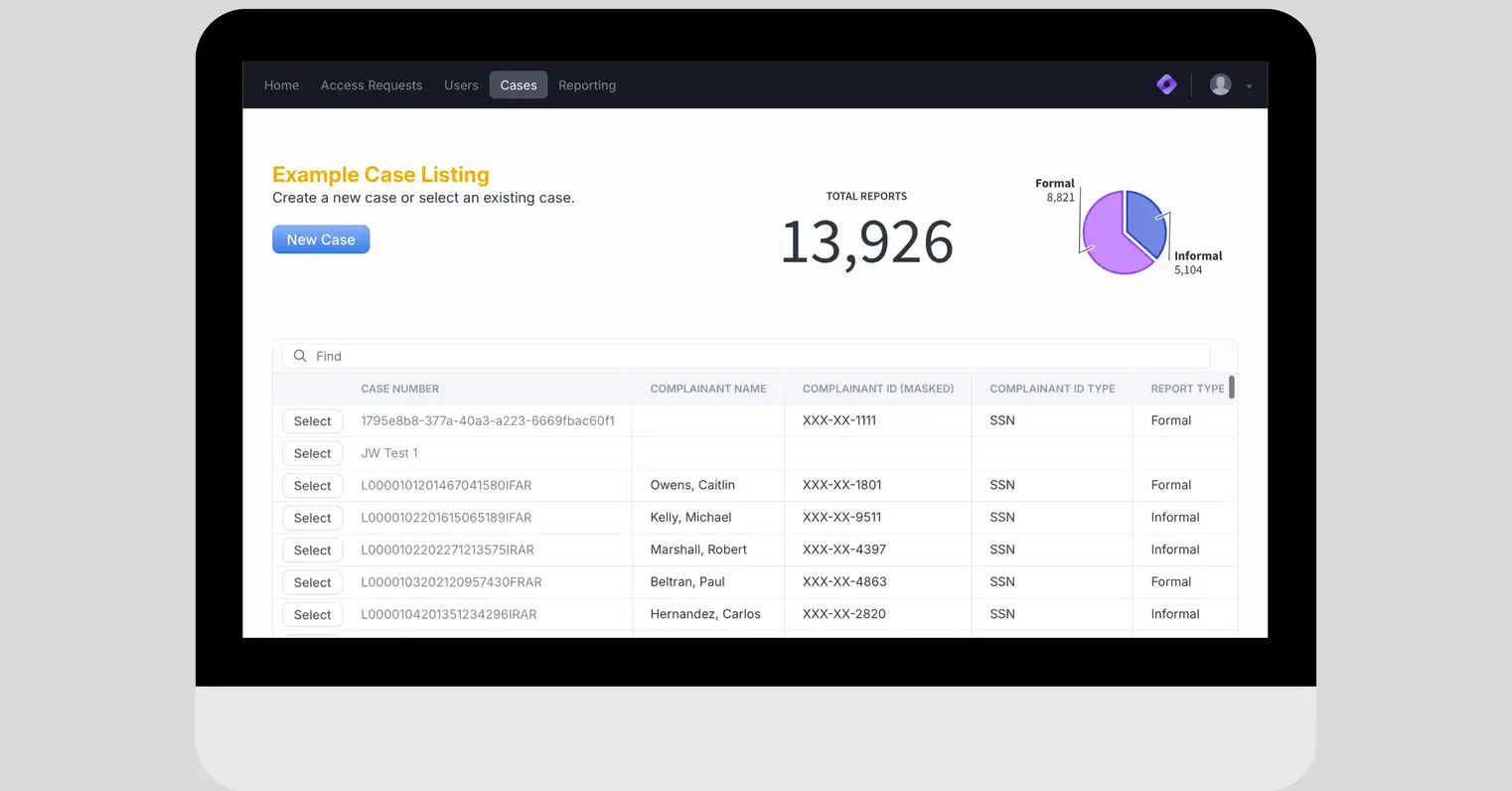
Incident tracking with audit trails means every case—whether it's an employee relations matter, a workplace safety incident, an accommodation request, or an investigation—is documented in a consistent format from the moment it's opened. These applications function as true systems of record—not just repositories, but structured environments with built-in visualization, reporting, and workflow logic that make compliance data actionable.
HR can't afford to manage compliance reactively. The cost of a compliance failure—financial, reputational, and operational—far exceeds the investment required to build systems that prevent it.
Building a No-Code Compliance and Case Management Application
A no-code compliance application transforms how HR handles sensitive cases by creating a structured, secure, and auditable system of record from day one.
Incident tracking with audit trails means every case—whether it's an employee relations matter, a workplace safety incident, an accommodation request, or an investigation—is documented in a consistent format from the moment it's opened. Every update, comment, status change, and decision is timestamped and attributed to a specific user. Nothing can be altered without leaving a record. This level of documentation rigor is difficult to achieve manually and virtually impossible to maintain consistently across a high volume of cases.
Audit trails also change how HR approaches internal reviews. Instead of reconstructing a case history from email threads and memory, managers and legal counsel can pull a complete, chronological record in seconds. That capability is invaluable during investigations—and essential during external audits.
Regulatory reporting automation addresses one of the most time-consuming aspects of HR compliance: assembling data for required reports. Whether it's EEO-1 filings, OSHA recordkeeping, leave tracking under FMLA, or state-specific requirements, no-code applications can be configured to capture and organize the specific data points each report requires as cases are worked—not after the fact.
This shifts compliance reporting from a periodic, labor-intensive scramble to a near-continuous process. Data is collected correctly at the source, and reports are generated from a system that's already up to date. HR teams that previously spent days preparing for audits find themselves able to produce required documentation in hours.
Secure document management keeps sensitive case materials—investigation notes, medical documentation, legal correspondence, signed acknowledgments—in a centralized, access-controlled repository linked directly to the relevant case. Rather than storing sensitive files in shared drives with inconsistent permissions, every document lives within the case record and is accessible only to authorized users. This protects employee privacy, satisfies data security requirements, and ensures HR can locate any document instantly when needed.
The Strategic Value of Getting Compliance Right
Compliance isn't just a risk management function—it's a foundation for organizational trust. Employees who see consistent, fair, and well-documented processes are more likely to raise concerns through official channels and trust that they'll be handled appropriately. HR teams with strong compliance infrastructure spend less time in crisis mode and more time on culture and workforce development.
A well-designed performance management system and a strong compliance framework reinforce each other: both depend on consistent documentation, clear standards, and fair, transparent processes.
Use Case 3: Approval Workflows
The Hidden Cost of Slow, Manual Approvals
Approval processes are where HR work most often stalls. A compensation adjustment waits in a manager's inbox. A policy exception sits unreviewed because the approver didn't know it was there. An offer letter approval takes three days to complete a chain that should take three hours.
These delays have real consequences. Candidates accept competing offers. Employees grow frustrated with processes that feel opaque and slow. HR teams develop workarounds that bypass controls entirely—creating exactly the compliance exposure those controls were designed to prevent.
Manual approval processes also create a documentation gap. When approvals happen over email or in verbal conversations, there's no reliable record of who approved what, when, and under what conditions. That's a significant liability.
How No-Code Approval Workflows Fix This
No-code approval workflow applications replace ad hoc, email-based processes with structured, automated chains that are fast, transparent, and fully documented.
Multi-step approval chains allow HR to configure exactly who needs to approve a given action, in what order, and under what conditions. A standard job offer might require hiring manager approval followed by HRBP sign-off. A senior-level hire might add a VP and CFO to that chain. A compensation adjustment above a certain threshold might require an additional finance review. These rules are defined once and applied automatically—no manual routing required.
This consistency matters for effective performance management strategies as well. When compensation decisions and performance-linked actions follow a documented, consistent approval process, it reduces the perception of favoritism and supports a culture of transparency.
Automated notifications ensure approvers never miss a pending action. When a request enters their queue, they receive an immediate notification. If they haven't responded within a defined window, they receive a reminder. No request sits unreviewed because someone didn't know it was waiting. Submitters receive automatic status updates at each stage, so they're never left wondering what's happening.
This alone eliminates one of the most common HR frustrations: the status check email. When everyone can see where a request stands in real time, the need for manual follow-up nearly disappears.
Escalation rules provide a safety net for time-sensitive approvals. If a request isn't acted on within a specified timeframe, the system automatically escalates to a backup approver or supervisor. This ensures that urgent actions—like a time-sensitive offer or a leave approval with a legal deadline—never get stuck because of an unavailable approver. SLAs are enforced automatically, not through manual monitoring.
Approval Workflows Across the HR Function
The value of structured approval workflows extends across every major HR process:
- Talent acquisition — offer approvals, requisition sign-offs, compensation exceptions
- Compensation & benefits — salary adjustments, bonus approvals, benefit enrollment exceptions
- Employee relations — accommodation requests, leave approvals, policy exceptions
- Learning & development — training budget approvals, external program requests, tuition reimbursement
- Workforce planning — headcount approvals, restructuring sign-offs, contractor extensions
Each of these processes benefits from the same core capabilities: structured routing, automated notifications, escalation rules, and a complete audit trail. Build the framework once, and it scales across every workflow that requires documented approval.
Connecting HR Operations to Company Strategy
Automating HR workflows isn't just an operational improvement—it's a strategic one. But the full value only materializes when HR systems are connected to the goals and metrics that drive the organization forward.
Most HR teams operate in a paradox: they're responsible for the organization's most important asset (its people), yet their work is rarely visible at the strategic level. Performance reviews happen, compliance cases get resolved, approvals move through the chain—but none of that activity is connected to whether the company is actually hitting its goals.
No-code HR applications close that gap, but only when they're designed with strategic alignment in mind from the start.
From HR Activity to Business Outcomes
Consider what structured intake data reveals over time. Patterns in hiring requests across departments can signal where the business is growing—or struggling. Compliance case trends can surface systemic issues before they become organizational risks. Approval cycle times can expose bottlenecks that slow the business down in ways leadership doesn't see until they're significant.
This is the difference between HR as a transactional function and HR as a strategic partner. When your workflows are structured and your data is clean, you can answer questions that matter to the C-suite: Where are we losing time in the talent pipeline? Which teams are understaffed relative to their goals? Where do compliance risks concentrate?
Aligning HR Workflows to Strategic Goals
The most effective HR teams build their no-code applications with an explicit connection to organizational strategy. That means:
- Linking intake processes to workforce planning goals — If the company's strategic plan calls for expanding a particular capability or market, hiring intake workflows should reflect those priorities, routing and flagging requests that align with strategic headcount targets.
- Using compliance data to inform culture and risk strategy — Case management data, analyzed in aggregate, tells a story about organizational health. Leadership teams that review this data regularly can make more informed decisions about where to invest in management development, policy reform, or culture initiatives.
- Tying approval workflows to financial and operational KPIs — Compensation approvals, headcount decisions, and training investments all have direct financial implications. When these workflows are structured and connected to budget parameters, HR becomes a more credible voice in strategic planning conversations.
Spider Impact is uniquely positioned to support this connection. As a platform built for strategy execution and performance management, it bridges the gap between day-to-day HR operations and the strategic goals that define organizational success.
HR workflows built in Spider Impact Apps don't exist in isolation—they operate within a broader framework that connects people decisions to business outcomes.
When HR leaders can walk into an executive meeting with structured data showing how workforce investments are tracking against strategic goals, the conversation changes. HR stops being a cost center that leadership tolerates and becomes a function that leadership depends on.
What Changes When You Get This Right
When HR teams operate with structured intake processes, robust compliance systems, and automated approval workflows, the day-to-day work fundamentally shifts.
Less time chasing down missing information. Fewer requests lost in email. No more compliance documentation assembled from memory at audit time. No more status check emails on approvals that should have been completed days ago.
What replaces that administrative overhead? Capacity. Capacity to focus on workforce development, strategic planning, culture building, and the work that actually requires human judgment and relationship expertise.
The technology isn't the transformation—it's what the technology makes possible.
Build Your HR Workflows With Spider Impact
Spider Impact's no-code Apps platform is built for HR teams who need to move fast without relying on IT. You can design structured intake forms, compliance case management systems, and multi-step approval workflows that match your specific processes—and launch them within days, not months.
Schedule a demo to see how Spider Impact Apps can transform your HR operations.
Frequently Asked Questions
What are the main advantages of no-code HR workflows over manual systems?
No-code HR workflows eliminate data silos, reduce administrative burden, and improve data accuracy compared to manual tracking systems. They allow HR teams to build custom applications that match their specific processes without technical expertise or lengthy implementations. These digital systems provide unified employee profiles, automated approval processes, and comprehensive reporting capabilities while preserving the human judgment and organizational culture that make HR teams effective.
How do you identify which HR processes are best suited for no-code automation?
The highest-impact automation opportunities involve processes with multiple handoffs, approval chains, or data flowing across different systems. Look for workflows that already have defined steps and clear outcomes, such as employee onboarding, performance reviews, or leave requests. These processes typically create coordination headaches through email chains, manual tracking, and scattered information, making them perfect candidates for digital transformation while preserving existing team dynamics.
What security considerations should organizations address when implementing no-code HR systems?
No-code HR systems must implement granular access controls that ensure team members only see information relevant to their roles. This includes role-based permissions where HR administrators have full access, managers see only their direct reports, and employees access personal information and relevant organizational resources. Additionally, source-level data validation prevents errors before they become compliance issues, while automated approval workflows ensure sensitive changes receive appropriate review with detailed audit trails.
How can no-code platforms create unified employee profiles from scattered data sources?
No-code platforms excel at integrating fragmented employee information by establishing clear data relationships between all employee touchpoints. Effective unified profiles connect performance metrics, training completion, career development goals, and compensation history into interconnected datasets accessible from a single interface. This integration transforms scattered information in spreadsheets and separate systems into comprehensive employee profiles that enable strategic workforce decisions and reveal patterns in performance, engagement, and retention.
What timeline can organizations expect when transitioning from manual HR processes to no-code systems?
No-code HR systems can be implemented and launched within days rather than the months required for traditional software development. Organizations can build practical solutions immediately, such as employee onboarding systems or performance tracking applications, and start seeing benefits right away. The rapid implementation timeline allows HR teams to create custom applications that match their specific processes quickly while maintaining flexibility to refine workflows as organizational needs evolve.
Newest Posts

Outcome vs. Output Metrics: Why Activity Doesn’t Equal Progress

Strategy Without Visibility: Why Leaders Struggle to Track Progress

Strategy Management Software: How to Align Planning, Execution, and Performance
Previous Posts

Strategic Planning vs. Strategy Execution: Why Great Plans Fail (and How to Fix It)
From Spreadsheet Chaos to System of Record: How to Centralize Your Organization's Critical Data

Strategy-Led Business Intelligence: Transform Data Into Strategic Action
Demo then Free Trial
Schedule a personalized tour of Spider Impact, then start your free 30-day trial with your data.